  |
        |
|
|
|
KENYA 2014/2015 CROP ASSESSMENT – 10/14/14 As we expected last years 2012/13 crop ended at 44,000 Metric Tonnes and for this year (2013/14) we have seen the coffee sold at the auction was 671,000 bags. Assuming that the direct sales would be around 10% in line with previous year's trend, this may have been around 67,000 bags, bringing the total to around 738,000 bags, which is equivalent to 44,286 Metric Tonnes. As we mentioned in our last report, mainly due to unstable coffee prices, the farmers are diversifying into maize, banana, apple and tree growing. According to the World Agroforestry Centre, it noted that the young farmers in Kenya are"losing patience" with coffee and venturing into other enterprises or moving to the cities. It also noted that the decline in coffee production among smallholders farmers is mainly dues to lack of access to credit, inadequate transportation andcommunication, poor banking infrastructure and poorly managed cooperatives. In February, we saw new political development whereby the Governor of Nyeri and four others from Kiambu, Meru, Murang'a and Kirinyaga counties resolved jointly that they would employ a common approach in marketing coffee for "the benefit of farmers" in their region. This created a lot of distraction and since this was the first time the farmers were involved in marketing coffees, it also created a huge opposition by many stakeholders in the industry, and finally it resulted in coffee getting back to the market through regular channels from April 2014. However, during that period, some importers had been told that the Nyeri Coffees would not be available. By the time they knew they could get the coffee, they had already bought their coffee. The crop for the coming year, 2014/15, could be lower and indications are that the production may go down by anything from 20%-25% from 2013/14 crop. The major reason is that the rainfall had been very scattered for most of this year and as a result, the coffee trees did not go through the "drought stress" which is required for flowering. Furthermore, since the farmers had over committed themselves through unregulated loans the previous year, they do not have spare funds to spend on better crop husbandry with fertilizers and insecticides. ETHIOPIA 2014/2015 CROP ASSESSMENT - 10/14/2014 Ethiopian Coffee Production for the year 2012/13 was 486,000 Metric Tonnes, out of which Washed Coffee was around 145,886 Metric Tonnes and Unwashed Coffee was 291,772 Metric Tonnes. However, production for the year 2013/14 declined to 450,000 Metric Tonnes. Out of this, 30% was washed coffee and the remaining was unwashed coffee. The consumption of coffee in Ethiopia which comprises mostly of all the undergrades is very high, leaving only the washed and better quality of unwashed coffees for export. For reference, the exports of coffee from Ethiopia for the last 5 years were: Although the rains and bad weather at the beginning of the crop year had affected the quality and quantity, it improved during the second round of picking and so we expect the crop to reach the 55,00 MT we originally predicted. However, currently the weather is very cold with a lot of rain causing the cherries to prematurely start falling from the trees. To make matters worse, the Coffee Berry Disease (CBD) is becoming an epidemic. As a result, we estimate the 2012/13 crop year will see a drop of at least 20% to 44,000 Metric Tonnes. A long-term trend in the future is the increasing reduction of land available for coffee growing due to population growth. As a result the farmers in Small Holder areas are uprooting coffee trees and growing more cash crops to feed their families. As the sons of farmers marry, the farmer sub-divides his farm giving plots to the new families who, in turn, build their own homes and grow their own cash crops, thus further reducing coffee production. Larger estates have also started uprooting trees and selling their valuable land to developers of homes & commercial properties especially in Kiambu, Thika, part of Miranga, and even in some Nyeri areas. Thus land where coffee is grown is becoming further reduced. Fortunately, new coffee growth is starting up in the Rift Valley region although the conditions are not as perfect as in the Central Highlands of Kenya. Growers are beginning to plant a new variety of coffee there called Batian, which was discovered by the Coffee Research Foundation last year. This variety will be available commercially in 2-3 years. The advantage of Batian is its resistance CBD and gives a high yield (40g more coffee per coffee tree). However, it is too early to say whether it will be comparable to the famous St. 28 & St.34 varieties. Our fear is that down the road, the producers, millers, and marketers will no longer sell the different varieties of Batian, Ruiru 11, St. 28, and St. 34 separately but will bulk them together and sell them as generic "Kenya Coffee"! Through all this, there is a political unknown that will certainly affect Kenya coffee in the future. The issue centers on proposed constitutional changes, yet to be enacted, to bring more transparency and accountability to the Cooperative Societies' corrupt leadership. Those who control these Societies currently hold the farmers in a virtual servitude far greater than the colonialists ever did.... We’ll see.
Ethiopia export for the first ten months of last year amounted to 113,632 MT for the first ten months, 28% lower than the previous year, from a total production of 498,720 MT. 60% of this was washed and 40% unwashed. Next year's production is assumed to be the same as this year's. KENYA 2010/2011 CROP ASSESSMENT - 6/29/2011 ETHIOPIA 2010/2011 CROP ASSESSMENT - 6/29/2011
We attended this year's EAFCA (East African Fine Coffee Association), which was held this year in Mombasa, Kenya in February. The attendance has been significantly increasing at these annual conferences and this year there were 700 delegates. EAFCA, is dedicated to the marketing and promotion of East African coffee and continues to grow and now represents the interests of eleven countries, Kenya, Uganda, Tanzania, Ethiopia, Rwanda, Burundi, Zambia, Zimbabwe, Malawi, South Africa and most recently, The Democratic Republic of Congo. Last year's membership consumed 172,000 Metric Tonnes of the 611,000 Metric Tonnes of coffee that was produced, Ethiopia was its biggest consumer at 150,000 Metric Tonnes. Not surprising, as Ethiopia is the original home of the coffee plant and so has a rich coffee culture.
As the above conference was held at our home base, we were able to host our customers and friends attending the conference with a private luncheon, tours of the excellent port facilities and of our own company's Quality Improvement Facility. Our hope is that all our customers who are planning future trips to Africa will include Mombasa on their itinerary. We will do our very best to make your visit a memorable one.
Rain, rain and continuing more rain since last years assessment has wreaked havoc with production and quality. As a result, the anticipated 53,000 Metric Tonnes production for the 2009/10 year is coming in at a much lower 40,000 Metric Tonnes number with many mills closing down earlier for lack of stock. Because of the continuing rain, proper flowering for the coming November crop has suffered too, which will translate into lower yields this coming main crop. At best, our long range crop forecast for 2010/11 will be about the same as this year's, at approximately 40,000 Metric Tonnes. This much-reduced yield is not good for the farmer financially. Yet despite the current situation, we are optimistic for Kenyan farmers are a tough, hearty lot…they are survivors.
Ethiopia's production is quite the opposite of Kenya's. It is up significantly from last year's to 480,000 Metric Tonnes. However they are not immune to escalating homegrown problems. First of all, there is the shortage of electricity, which results in its rationing (detailed below in last year's assessment) which continues to worsen. In addition, there is a continued bottleneck of containers piling up at Djibouti, which happens to be the only viable port from which to export to the rest of the world. The storage and port handling charges have significantly increased, and compounding the cost, is the growing cost of transport fuel to the port. This situation seems to have no solution for the foreseeable future and is best characterized as chronic and incurable. Our job at Moledina Commodities is to insulate our customers from these headaches and provide the best service quality coffee possible. KENYA 2008/2009 CROP ASSESSMENT – 7/9/09 Unfortunately, the final 2007/08 crop ended at 42,333 metric tonnes, 15% lower than what we had predicted. Again, the weather played havoc as the late rains caused the flowers to fall of prematurely and also prevented some existing cherries to ripen properly. Out of the total crop, 25,635 metric tonnes were produced by the Co-operative Sector and 16,698 by the Estate sector. Since we had fantastic weather towards the end of last year, we had predicted a banner year for the 2008/09 crop. We haven’t been wrong as this year’s crop is estimated to settle in around 60,000 metric tonnes, of which already 57,831 metric tonnes have been harvested. The Co-operative sector has produced 35,709 metric tonnes and the Estate sector has produced 22,122 metric tonnes. 80% of this coffee has been sold through the auctions and the balance through direct sale. Due to heavy flowering in January and February of this year, we thought the 2008/09 crop would end up even higher at 65/70,000 metric tonnes, but the rains which were supposed to boost this early crop to close the 2008/09 coffee year have failed. This means that the main crop for 2009/10 season will be affected. We predict the 2009/10 crop to drop to 53,000 metric tonnes. Recently, we have seen a substantial improvement in the management in the administration of the coffee practices which has motivated the farmers to work harder leading to higher income realizations. While the increasing cost of fertilizers, fungicides, fuel and increasing levies in irrigation water are putting a damper on potential growth, the problems within the Co-operative sector in some areas still remain the major bottleneck to the full recovery.
ETHIOPIA 2008/2009 CROP ASSESSMENT – 3/9/09 The 2008/09 estimate is around 368,000 metric tonnes and if the current favorable weather continues, we project the 2009/10 crop to expand to about 394,000 metric tonnes. The local consumption in Ethiopia still remains around 40% of the annual production. The high differentials that are currently demanded for the Ethiopian coffees will certainly help the government to receive the much needed foreign exchange from the coffees sold abroad. The global economic crises have not escaped Ethiopia. The government is trying its best to handle the local economy and one of the steps it has taken to tackle the economy is to ration the daily electricity supply to every other day. However, even on the day when the electricity is supposed to be on, it suddenly is disrupted or is turned off completely for the day. This, no doubt, has brought the coffee industry to a practical stand-still as without the electricity, the coffee processing equipment at the mills, lights needed for hand-picking coffee, office equipment, including telephone, computers etc. all come to a halt. Unfortunately we do not see this situation improving in the near future. The second deterrent to the coffee industry has been the establishment of the Ethiopian Coffee Exchange (ECX) by the government last April 2008 and which came into operation in December 2008. Prior to ECX, the sellers would bring their coffees on trucks to sell them at the coffee auction. 90% of the coffees would be left on the trucks and the rest of it would be stored and the sellers had 3 days within which they had to put their coffees for sale at the auction. The buyers, after they purchased the coffees from the auction, were able to take the deliveries of these coffees immediately. The buyers also never had to pay for the coffee bags. With the establishment of the ECX, the government has inadvertently brought unwanted bureaucracy in the industry whereby all the coffees are now stored in the government warehouses on behalf of the sellers. But now, the buyers have to pay for the coffee bags, pay storage charges, wait in long lines to take deliveries of coffees as trucks sometimes have to wait upto 20 days in line to pick up coffees. In most cases, the buyers now incur additional demurrage charges. Furthermore, the sellers are now able to store their coffees at these warehouses for upto 3 months. This has led to the sellers speculating and holding the coffees until they feel the prices are high enough for them to sell at the auctions.
“AND THE WINNER IS…..MOLEDINA’S GATAMBOYA – 11/5/08 Moledina Commodities’ reputation for supplying the best of the best continues according to the Pacific Coast Coffee Association at its Pete McLaughlin Cupping Competition in Hayward, California on May, 22, 2008.
Of the 36 submittals, our Gatomboya AA was picked as the best coffee from Kenya by 41 cuppers who had participated at this annual competition. The Gatomboya Factory, from the Nyeri district of Kenya, is one of the four factories belonging to the Baricho Farmers Co-operative Society. The 300 small-scale farmers that belong to the Gatomboya Factory have consistently produced some of the finest coffees from Kenya. In 1997, it was from this same Gatomboya factory that we paid the highest price of $1,080/50 kilos that was ever paid at the Kenyan auction. We are so proud of the hard work of these very dedicated farmers who produce 1,500 bags annually, out of which only 450 bags are of AA grade.
KENYA 2007/2008 CROP ASSESSMENT – 2/15/08 Final figures for the 06/07 crop are now in at 51,762 metric tonnes, up from the previous year and only slightly less by 1,238 tonnes than our prediction a year ago. (Not bad!) Due to increasing world demand, the farmers are enjoying higher prices and now investing once again in improved husbandry. This includes efforts to rehabilitate abandoned farms and renewed interest in political reforms effecting coffee marketing and quality --- all to the good. However, countering this was the weather. Though the rains started as usual last April, they continued on relentlessly through last summer to October which caused a lot of flowers to fall off prematurely and also prevented some existing cherries to ripen properly. We therefore predict that the 07/08 crop will be down 10% coming in at about 48,000 tonnes. This lack of proper ripening will also result in lower quality --- not so good. But there is a silver lining behind these clouds in that this super, saturated past season has set the stage for a fantastic future. So far the 08 weather has been really good and if the periodic rains continue, the flowering will be incredible resulting in an 08/09 banner year for both quantity and quality. We are excited. As to the social unrest caused by what many are saying was a stolen national election, both sides are trying to cool down thanks to the mediation efforts headed by retired UN General Secretary, Kofi Annon and other prominent Africans. So far, there have been no significant problems in the coffee producing areas although everyone is jittery. Our hope is that the rival Kikuyu and Luo tribes involved will realize that the Kenyan economy is dependent on coffee and tourism the future of which is dependent on peaceful political accommodation. As a side note, US Senator and presidential candidate Barrack Obama’s father is from Kenya’s Luo tribe. ETHIOPIA 2007/2008 CROP ASSESSMENT – 2/15/08 The 2006/07 Ethiopian crop increased to 321,000 metric tonnes out of which 236,710 metric tonnes was exported. And the reason the Ethiopian coffee industry is continuing to grow and prosper is for the following reasons:
For these reasons we are
projecting the 2007/08 crop to continue to expand to around 344,000 metric
tonnes. The final 2005/06 crop came in at 48,297 tons, lower than our estimate of 52,000 tons. This was mainly due to delayed payments, high cost of production, indebtedness and lack of affordable credit and farm inputs. However, due to recent price improvements, farmers are making efforts to improve the quality and quantity of coffee. We, therefore, estimate the crop for the year 2006/07 to be around 53,000 tons.
Unfortunately, we are also seeing an increase in demand for planting materials such as Ruiru 11 seedlings, especially amongst the large Estate farmers. Although, this variety matures faster, cuts production costs by 30% and is resistant to coffee berry disease and leaf rust, it still does not come close to the original unique Kenya taste of the original bourbon varietals like SL 28 and 34. We constantly encourage the growers and especially the small scale farmers to continue with the original varietals in order to maintain the high quality of coffee with its unique taste, otherwise they will just commoditize the coffee in Kenya and it will soon become like any other ordinary tasting coffee of the world. The "Second Window" is now officially open in Kenya, yet the first direct purchase contract has yet to materialize due to legal responsibility issues required of those who enter into the contract. We shall keep you informed on any developments.
EAFCA CONFERENCE IN ETHIOPIA – 3/19/07 I had the pleasure of attending the Forth Annual Conference of EAFCA in Addis Ababa in February 2007. Being one of it founding members (Membership Number: 004), I am proud of its progress. In the short time since its inception in 2000, it has done extremely well by opening its membership to all players in the coffee value chain. EAFCA’s ultimate aim is to improve the quality of life of the small, coffee growers upon which the future of the trade depends. Promoting fine coffees at fair prices is the EAFCA strategy to achieve this goal.. We couldn’t agree more. To do this, EAFCA has helped form linkages and relationships amongst its ten member countries. As a direct result of the linkages formed at its conference, EAFCA anticipates generating $20 million in fine coffee sales for the year. With USAID’s support through the RATES program, EAFCA is also now successfully providing marketing and educational services to its members. This includes training in post harvest processing, roasting and blending, cupping, marketing and barista championships. USAID intends to continue to support these efforts to increase the quality of coffee in East Africa on into the future.
ETHIOPIAN 2006/07 CROP ASSESSMENT – 3/19/07 The 2005/06 crop in Ethiopia came in at 270,000 tons, out of which 150,417 tons was exported and the rest was consumed locally. It is encouraging to see that the export during the last 3 years has steadily increased from 136,614 tons in 2002/03 to 150,417 tons in 2005/06. This is mainly due to increased production and improved crop husbandry. The Government in its 2006/07 Fiscal Year Policy is encouraging further expansion of exports to 200,000 plus tons to mark the upcoming Ethiopian Millennium. To every ones benefit, the income of farmers is now on the rise due mainly to sustainable trades. The share of Fair Trade and Organic Certified coffee has increased as well as that of washed coffee. Of note is that growers in the East and Southwestern producing regions, reacting to the uncertainty of international market prices, have, unfortunately, turned their attention to the production of Qat which fetches ten times as much as coffee.
“SECOND WINDOW” IN KENYA: STILL IN THE AIR – 3/15/06 As readers know, the much touted
“Second Window”, considered to solve every ones problems in Kenya, has
been in effect for few years in Tanzania. Records show that 93% of
farmers have opted to sell still through the auction system, deciding it
was in their best interest to achieve the best prices. So, in the end,
Tanzania’s Second Window has turned out to be “Much Ado about nothing.”
Our opinion is that it will have the same fate in Kenya. In as much as we
agree that the farmers must be given a choice to market their coffees,
they will soon realize that once they have the opportunity and have burnt
their fingers a few times, they will come running back to sell at the
auctions. As we write, the rules for this Second Window have still not
been gazetted, although we have been told that they would be for nearly a
year now. Even if they are known soon, they will have to be enacted into a
law, which could take some time since the Kenyan Parliament is not in
session and when the law makers do return, they have many other urgent
matters to discuss on their plate. As a result, the “Second Window” could
be pushed to the back burner once again! This week, we saw an increase to
36,000 bags being offered as compared to 26,000 bags last week. Is this a
sign that the farmers are getting tired of waiting, lest they miss the
current up-tic in prices? So, the bloom is off the rose even before
Second Window has hit the streets. KENYA 2005/06 CROP ASSESSMENT - 3/15/06 A year ago we projected a 60,000 ton crop for the 2004/05 year. But this came in at 49,510 ton due to the continuing drought. Recently, the Coffee Board of Kenya has predicted that due to draught, which resulted in famine, could cut the 2005/06 harvest by between 15-20% from their earlier estimate of 65,000 tons. Fortunately, the rains have started again to the point where much of both the fly crop and especially the main crop will be saved. So our sense is that the crop will now come in at about 52,000 tons --- still an anemic figure but not the catastrophe that would have been.
During my visit to few farms on our annual Moledina Kenya Coffee Safari just before the rains, I noticed the coffee trees looked very depressed. Hopefully, the rain will help a little. But it was also obvious the farmer has not been able to afford good crop husbandry due to lower prices of coffee. The representatives of the one of the Co-operatives asked us quite openly to help them to buy fertilizer and insecticides as they had no money to maintain their trees. I was very saddened to see this desperation and feel very strongly that the government has to intervene and revive the co-operatives with better management to help the farmers get out of this economic plight.
EAFCA ON TRACK - 3/15/06 I recently returned from Arusha, Tanzania and the Third Annual Conference of EAFCA, a first for me despite being one of the founding members of this organization. EAFCA was established in 2000 to “promote partnerships and networks amongst those participating and having an interest in quality coffee production, processing and marketing in the Eastern Africa coffee-growing region”. The enthusiasm, program quality and energy of the 500 attendees was matched only by the progress EAFCA has made in trying to achieve its mission.
I visited couple of farms in the Kilimanjaro and Arusha region and was struck by the care and improved husbandry of these growers. As with Kenya, the drought has taken its toll, especially in the area visited. The original projection for the 2004/5 crop had been 56,000 tons but now the officials are predicting only 45,000 – that’s the bad news. The good news is that the rains have finally come, just in time to have a positive effect. I estimate that the final tallies will come in at about 50,000 tons. My hat’s off to the Tanzanians.
CHANGES BREWING – 3/23/05 A year ago we predicted a 65,000 ton crop for Kenya. Unfortunately bad weather and mismanagement within the industry conspired to lower the actual crop to a dismal 51,700 tons. This being said, were going to stick our necks out again. The Early Crop is now in and up 50% from last year, 60,000 bags compared to 40,000. Based on this and reports of heavy cherry picking in most regions, good drying weather, and settlement of disputes between farmers and authorities we boldly predict .... absent interference from mother nature .... a larger crop for this year, perhaps 60,000 tons. All indications are that quality will be up as well. The beans are larger, farmers are taking renewed interest in their husbandry, and, in general, they are more positive and optimistic. We will keep you posted as Mother Nature always has the final say. INDUSTRY CHANGE?? – 6/10/04 The model of retailing beverage coffee as opposed to whole bean sales is such a force that it is now the adopted norm of the Specialty Coffee Industry as whole. Since most of the beverage coffee is based on espressos, it requires less and less of the fine specialty coffees with high acidity and overall flavor upon which the Industry was founded 30 years ago. As a result, such specialty quality coffees have been less and less in demand. From the beginning, Moledina Commodities with its close ties in Kenya and Ethiopia has always based its business on the finest Arabica beans. We will continue to do so into the future and pledge only the highest quality to our loyal, quality committed customers. This being said, some of our customers are not sitting still and are developing new strategies of their own to maintain and increase their market share. New blends using more and more of the fine coffees like Kenyans as the “magic ingredient” are turning the tide. The point here is that high quality always has a place in the market even if only in “disguise”. We personally believe, that although it is trendy to use these fine coffees like Kenyans to uplift the rest of the blend, in the long run, the success of specialty coffee as we know it, will depend largely on promoting the best Arabicas as single origin coffees. In offering these fine Kenyans as a single origin, there is so much to say and write about them as to surely fascinate the discriminating consumer and bring them back. Single origin can also be promoted as single origin espresso as some fine specialty coffees on their own can beat any espresso blend hands down. The larger issue is that, for the best of the best coffees of origin, there is even more potential profit to be made than ever before as the rest of the industry slides ever further down into the mediocrity. Our business model is to
provide the best of the best coffees of origin to those who insist on
the highest quality. BUCK’S COUNTY COFFEE COMPANY A DOUBLE WINNER – 6/1/04 In the latest Coffee Review’s blind cupping results, Buck’s county Coffee Company of Langhorne, Pennsylvania took first place in both the Kenyan and Ethiopian categories. Said Buck’s County’s
President, Rodger Owen, “We are delighted to be the recipient
of the best Kenyan award. In mentioning the award, Ken Davids, founder
and cupper of www.thecoffeereview.com
said he considered this lot of Kenya as the finest he had cupped since
founding of the award seven years ago. He gave us the highest rating
ever, 95 out of 100. He also awarded our Ethiopian Yirgacheffe a grade
92. Both these fine coffees were supplied to us by Mohamed Moledina
of Moledina Commodities in., of Flower Mound, Texas. The coffee Moledina
provides has made it possible for us to please literally thousand of
our customers. We value and are grateful for Moledina’s expertise
in the Specialty Coffee Industry and can’t think of a better way
to increase sales ….. have the best coffees.” KENYA COFFEE INDUSTRY IN GRIPS OF A CRISIS – 11/5/03
Having just returned from our annual “Moledina Coffee Safari”, I can report that the fly crop shows some promise of quality for the coming year. However, I find that the Kenyan Coffee industry in the grips of a crisis created by poor global prices and serious internal mismanagement. Production has been falling gradually from 130,000 tonnes in 1987/88 to about 50,000 tonnes in the coffee year just ended. About 750,000 Kenyans used to be employed in the coffee industry but now the number has fallen to around 220,000. The biggest reason that has discouraged production is the crippling debts incurred by the growers. Most farmers today cannot even get bank loans due to bad credit. A government appointed task force on coffee marketing has just come out with some proposals last month. The most important one is that the Kenya government consider asking the banks to cancel around 10.5 billion Kenya shillings ($134 million) owed by peasant coffee farmers. Furthermore, the government itself should set aside 5.0 billion Kenya shillings ($64 million) as a coffee development fund for long-term credit to be used in rehabilitating the industry. The task force also asked the government to pressure the state-owned regulator, the Coffee Board of Kenya to quickly pay a total of $8.5 million owed to farmers since May 2002. The extra cash flow should certainly help to revive the coffee production. The most ingenious suggestion of the task force is to create Kenya Coffee Development Agency (KCDA), a clone of the relatively successful Kenya Tea Development Agency which has less cost centers. The KTDA has only 51 tea factories owned by farmers themselves and they can elect or fire the factory officials on their performance. Whereas, previously under 250 or so co-operative societies that served the coffee farmers, the officials were appointed by the governments and they practically had “carte blanche” to do what they liked and remain as long as they had relatives in the government. The KCDA would undertake the management of the coffee sub-sector, offer credit for acquisition of inputs and coordinate marketing and payments to growers. In our opinion, the implementation of this report will be a “hot” political issue and not easy to implement. There was no unanimity in its creation and the three existing, licensed coffee millers will put up a fight to preserve their lucrative marketing franchises. None the less, it does offer the hope of reviving the industry. KENYA 2003/04 CROP ASSESSMENT – 11/1/03The Coffee Board of Kenya’s production estimate was most accurate for the year 2002/03 as the final figure came in just over 59,000 tonnes, which is an increase of 7.2% from the previous year. This was mainly due to favorable weather conditions. One wonders what would have been the total production if some of the farmers had not uprooted coffee trees as was reported in some areas and if some of them had more money to spend on better crop husbandry. Despite higher production, the export quantity and earning fell 3.8% and 18.2% respectively during the October 2002 to August 2003 period due to poor demand from overseas and continuation of depressed world prices. (See chart below). The overall quality was also poorer as farmers just do not have the money to take care of the trees. The production for 2003/04 is expected to be around 65,000 tonnes, but a lot will depend on whether the government and the coffee industry solve the internal mismanagement problems within the of the coffee sector. The Top Ten Importers of Kenya Coffee October 2002 – August 2003
ETHIOPIA 2003/04 CROP ASSESSMENT – 11/1/03With by far better weather than expected, the Ethiopian coffee production for 2002/03 period was just over 230,000 tonnes, slightly higher than the previous year’s production. Out of this production, 93,386 tonnes were consumed locally and 136,614 tonnes exported . This is an increase of 34% in local consumption but a 13% decrease in exports. This is quite understandable as with the global prices still below the cost of production, there is no incentive for farmers to export. The quality also dropped due to the falling revenues’ inability to support proper crop husbandry. Some farmers have even uprooted their coffee trees and are instead growing other cash crops. Their favorite is growing Qat, a mild stimulant chewed in most of Eastern Africa and the Arabian Peninsula (except in Saudi Arabia, where it is banned). Qat, which is legal in Ethiopia, yields four crops per year as compared to one crop of coffee. Qat fetches as much as 10 times the price of coffee. Who can blame them? The 2003/04 crop estimate is little difficult at the moment as the first flowering has not been good due to hot temperatures. As a result, we will have to wait for the second flowering before we can give our own best estimate. For what it’s worth, however, the Ethiopian Coffee & Tea Authority is optimistically predicting an export figure of160,000 tonnes. We’ll see ……. A MOMENT OF VICTORY – 11/22//02 As we celebrate our 20th year in business in the United States, we have always taken pride in providing the best quality and service to our customers. Over the years, it has been very gratifying to receive a small hand written “Post-it” note on a copy of the contract or a check, saying “Thanks” for providing the best coffee etc.; or a phone call to say “Wow, this coffee was just incredible.” We have been mentioned favorably in many company newsletters and trade publications. We have even got world press coverage for paying record prices for the finest coffee ever produced in Kenya. So it does not surprise us that this year, we provided Allegro Coffee Company and Community Coffee Company were recognized as the coffee companies receiving the two highest ratings on taste evaluations with the lots we had provided for the September 2002 Coffee Review Panel Cupping Contest of Kenyan and Ethiopian coffees.
Chris Thorns, Coffee Buyer of Allegro said after winning the top prize, “Allegro
Coffee Company is known throughout the coffee industry for consistently
buying the best Kenyan lots available at the weekly auctions in Nairobi.
This year was no exception, as Allegro once again received the highest
rating from the Coffee Review cupping panel with a score of a 93 for their
selection of Kenya AA. This is one of the highest ratings ever given by
the distinguished panel of coffee experts and appreciations must go out to
Moledina Commodities Inc., supplier of this year's winning lot from the
Ndaroini cooperative. After searching out the best lots presented for the
weekly auctions, Mohamed Moledina, president of Moledina Carl Leonard, The Green Coffee Procurement Manager at the Community Coffee, said very kindly, “Thank you for continuing to provide the high quality coffees that enable Community Coffee to provide what our customers expect from us … “Quality, Consistency, and Value.”
PLIGHT OF A SPECIALTY COFFEE FARMER – 11/02/02 After writing my recent updates for Kenya and Ethiopia, I have been constantly thinking and obsessed by the plight of the peasant farmers, not only in Kenya and Ethiopia but throughout the world where most of the specialty coffee is grown by a small scale farmer. Coffee prices have dropped 75% since it peaked at $1.81 a pound in May 1997. With the current world prices, which are below the cost of production in many countries, I just cannot understand how a small farmer is able to feed his family and live a “normal” life. We have seen very few (and we repeat few) articles describing their grave situation but no one is doing anything about it or even trying to offer any solutions. Proctor & Gamble, Nestle, Sara Lee and Phillip Morris are obviously not saying a word. Nor are the trade associations speaking out for their producing members. It seems recently only Oxfam has tried to bring forward the plight of coffee farmers. If nothing is done about it now, and we know Vietnam and especially Brazil continue to grow more coffee trees everyday, we believe in 10 years there will be no specialty coffees available from many of the African and Central American countries. One solution is getting back to ICO quota system. With all its faults, by maintaining the price band of $1.20 - $1.40, this system provided a happy and a reasonable living standard to everyone from seed to cup for 26 years until the quotas were suspended in July 1989. It is going to be an uphill battle to convince the US Government and especially the “big” boys to return to price quotas. But with enough pressure from the rest of us in the industry and if we can get our trade associations to take this case seriously, we believe we can halt this crises. A slight lower adjustment of the price band, say to $1.00 - $1.20 may just convince the “big” boys to see justice and reason while the Government can be convinced that this would indirectly provide financial aide and stability to many third world countries. Otherwise, the alternative is most grave. About 100 million people depend on their living on growing coffee in more than 50 developing countries, who in turn, depend heavily on coffee export earnings, some even more than 80%. Therefore, if this acute crises is not corrected NOW, many of these countries could face a catastrophic economic, political and social disaster, that could lead to violence and social unrest. Some of their people may start growing drugs, while many could die of misery and hunger.
ETHIOPIA 2002/3 CROP ASSESSMENT – 11/1/02 The total Ethiopian coffee production was only slightly less than last years production at 226,200 tons for the budget year of July 8, 2001 to July 5, 2002. Out of the total amount of coffee produced, 69,301 tons were consumed locally while 156,899 tons were exported. Of the coffee that was exported, 46,327 tons was of washed coffee and 110,572 tons was unwashed sun-dried. We found the overall quality acceptable, yet average compared to what we used to see few years ago. Due to cyclical effect and the current draught, we expect the next crop to be down by as much as 30 to 35%. Furthermore, the low world prices provide no incentive to the farmer invest in any farm inputs, which is such an essential part of crop husbandry. As a result, the quality should suffer too.
KENYA 2002/3 CROP ASSESSMENT – 10/31/02 The final production figure for the crop year 2001/02 came to 55,020 metric tons, even lower than our revised estimate of 60 – 65,000 metric tons on 1/18/02. Out of this production, total exports were only 48,050 metric tons as compared to 72,562 metric tons shipped in the previous year. As a result, the export earnings dropped sharply by over 42% to $81.63 million from $140.65 million the year before. The peasant farmers are totally discouraged with the concerns of the new coffee reforms, bad weather and the poor world prices and thus many have abandoned their coffee trees and growing other cash crops. Short of a miracle, the situation can only get worse. The Coffee Board of Kenya has
estimated that the production for the year 2002/03 will be around 60,000
metric tons. Since we have seen better weather recently, we agree with
their estimate. However, we have our reservation as far as quality is
concerned. At current below the cost prices, the farmer can in no way save
any money, especially for good crop husbandry. As a result, our job in
finding the best of the best is going to get even harder. But we would
like to assure you that, as always, we will try our darn best to get you
the best available. We have just returned from Kenya
and offer the following report. The
crop year ending September 31, 2001 closed out lower at 51,632 metric tons
due to poor weather. Unfortunately,
over-all quality too, was mediocre due to the inconsistent rains during
the final months of maturation. The new Coffee Act, 2001 As we have informed our readers in previous updates,
the long anticipated changes to the Kenya coffee governmental control
system contained in the Sessional Paper No. 2/2001 on the Liberalization
and Restructuring of the Coffee Industry, and Coffee Act, 2001 was finally
signed into law on 12/31/01. While
the full details are not known as the new bill is still at the Government
printers, we understand the administrative details will not be completed
for the next three months. However, we are optimistic that the new plan
will eliminate many of the problems that had grown ever more troublesome
over the past several years. The
following is a general outline of how the new system will work, as we
understand it. Thankfully, the Auction system, which puts all
buyers, large or small, on an equal footing, has been preserved. The Auction is a proven system that keeps the large
international cartels and monopolies from taking over the market of this
small country. It is the only
system that we know of, that establishes a true market price.
It is a “price discovery mechanism” as Simeon Onchere, the Deputy General Manager of Coffee Board of Kenya
recently put it.
The big change, though, is that the Auction will no
longer be the property of the Coffee Board of Kenya (CBK). The once all-sweeping powers of the CBK have been
significantly curtailed. Its
principle functions from now on will be only that of regulatory,
promotional and advisory services. The Auction, Marketing, Sample Room, Information
& Technology, Laboratory, Warehouse, Acct./Audit, etc. functions will
be covered by a new organization, The Kenya Coffee Producers and Traders
Association (KCPTA). The
KCPTA membership will be comprised of coffee growers, dry millers,
marketers, dealers, auctioneers and warehousemen.
An Executive Director will manage it. An emphasis here needs to be placed on the term
marketing and marketers. This
is a new classification that allows the growers to sell their coffee to
any one of several licensed “Marketing Agents” who in turn will then
bring their crops to the central auction of the Nairobi Coffee Exchange.
The marketing agent will have to provide in favor of the grower a bank
guarantee worth between US $1 million and US $12 million dollars, or one
and a half times the value of the coffee transacted on in each particular
case, whichever is the higher. Commentary: While
a new entity, we do not view the marketing agents as a new layer of
“middle men”, but rather a more efficient way to deliver the needed
value added services to the growers that already exist but are currently
haphazardly delivered, are of low quality, and way too expensive and
corrupt. We believe that this new system will correct much of these
ills, but no one will know for sure until it has some time under its belt.
April 1, 2002 is the switchover date to the new system. Supply of new crop Although things are still a bit up in the air until
the new changes take effect, there does not seem to be any supply
distortions brewing that we can see.
The new crop is coming in, with only a few of the farmers holding
their coffees back until they see what the marketing agents will bring to
their table. While Kenya is frantically doing what it can to make
its system more cost efficient, and will survive so long as its high
quality prevails, it too suffers from the worldwide over supply of coffee.
Up until only a few years ago, World supply and demand were pretty
much in balance, as were the prices.
Distortions to this stability were only caused by weather
anomalies. Over the past five years, consumption has not
increased to any significant level. What
has driven the prices downwards is the growing over supply caused
principally by huge production increases in Brazil and Vietnam.
World prices have dropped almost 60% as a result.
As a result about 30% of farmers in Kenya have abandoned their
coffee trees, due to poor returns, which are much lower than their
productions costs. Quality is
falling victim as well. Last
year, producing countries received only 14 cents of every dollar collected
at retail and the farmer gets even less.
There is so little “blood left in the turnip that one more
squeeze will turn it into a radish”. Can we help? We could ease the situation and help the coffee
growers in whatever small way we can. Moledina Commodities has been
supporting Hope & Mercy International Ministries, a Christian
Charitable Organization, which has been providing practical economic
development assistance to failing rural communities. In the coffee growing
areas of Nyeri, Hope & Mercy, in conjunction with Othaya Family Helper
Project, supports the Karima Grade Goats Self Help Group, building of
cisterns to store uncontaminated water for schools, and provides tuition
support to educate the children. While
the latter two need no explanation, you say goats?? Well, yes, goats.
As their husbands coffee revenues began to dry up and they could no
longer pay to educate their children, 125 mothers took matters into their
own hands deciding goats were the answer to providing extra needed cash. The Othaya Family Helper Project has been helping them build
the herd. Goats are low
maintenance, will eat just about anything including weeds and underbrush,
provide a good source of milk, spare milk is sold for cash, and, here is
the good part, a great source of free, high quality organic fertilizer for
their husbands’ coffee trees. For
more information on Othaya Family Helper Project, send us an email. Goodby Mr. Gatere
Mr. Gatere has been my cupping mentor and a good friend since I entered the business. Much of my success comes from what I have learnt from him. He was the best of the best at his trade and freely passed on his cupping skills to all comers. His baton has been passed to the very able Michael Mungai, another of his protégés. We will miss you, Mr. Gatere.
The changing weather patterns and
the worldwide depression in coffee prices for the past two years are
continuing to impact Kenya’s coffee industry.
For example, the traditional spring 2-month “long rain” and
fall 2-month “short rain” cycles have been out of whack for few years.
In the beginning, El Nino was blamed but that is now long gone and
the cycles should have re-adjusted but
haven’t. Last
year’s drought has been followed by 6 months (as of this writing) of
continuous rain. The good news is that this means a potentially bigger, higher
quality 2001/02 crop is in the making.
The bad news is that if these rains don’t taper off soon, the
cherries won’t mature properly. It’s
time for the sun to come out. There is a growing concern in
Kenya that these recent climatic shifts may be caused by the acceleration
of deforestation in the region and resultant thermal changes and soil
erosion. Deforestation
started in the forests around Mt. Kenya and Rift Valley and has now spread
even Langatta area of Nairobi. Only
time will tell if this deforestation will have any significant impact on
Kenya’s coffee industry. Thus the final 2000/01 crop will probably reach 61,000 metric tons, lower than estimated due to last year’s drought. Next year should be better because of the rains already mentioned. Quality should be better too assuming the sun cooperates. Yet prices are still depressed due to the worldwide over supply. While this is a short term benefit to coffee buyers, in the long run low prices mean a further lowering of quality levels to the detriment of all. Farmers are no longer tending to their trees due to the lack of money. More and more are being forced into other lines of work just to feed their families …. bare subsistence levels prevail. The Kenyan government is concerned enough now to the point where the parliament is currently studying The Coffee Act and ways to improve the industry. In our 12/5/2000 ASSESSMENT (see below) we made three recommendations the government could adopt that would ease the plight of the growers. We’ll have to wait to see what they finally decide. On a lighter note, concerning
deforestation: For our quality conscious customers, Moledina Commodities’ sole mission is to provide you with the only the very “best of the best” coffees from around the world. KENYA 2000/2001 CROP ASSESSMENT - 12/5/2000 Weather and Factionalism Take a Toll
Meanwhile, world coffee prices plummeted, dragging down the prices in Kenya as well. This coupled with the added costs of harvesting and handling of the much larger crop, put the farmers in a no-win situation – production costs way up with total revenues for the year down 20%. Adding fuel to the fire, the large cooperatives to which the farmers have always counted on for the mass purchase their supplies and market their beans, became unglued and factionalized. The convergence of these three forces, lower prices, quality, and fragmentation of the cooperatives could not come at a worse time for the farmers and the country as a whole. As we assess how all this affected our business, we see that, thanks to the hard work of our head office in Kenya, Rashid Moledina & Col (MSA) Ltd., (which in fact ranked #1 in Kenya Coffee exports from the 1999/2000), we were able to tip-toe through all these "mine fields" providing you with the very "best of the best" coffees.
For this year’s 2000/2001 crop we see continued problems. The drought that caused so much trouble last year, continues on relentlessly, greatly reducing the quantity. Our best estimate is 70,000 tons. As to quality, last year’s reduced dollar intake and splintering of the large cooperatives into many numerous smaller units has already had a negative impact. For example, with fewer dollars in hand, the farmers are no longer able to buy fertilizers and new equipment or, for that matter, even doing ordinary maintenance. At the same time, the unit prices they must pay for these items are higher due to the breakup of the large cooperatives with their mass purchasing power. Credit is scarce for the same reason. All this translates into reduced quality potential. Yet we are optimistic. Our hope is that the Grace of Mother Nature will bring to this troubled country well-timed rains to improve the quality. At the same time we hope that Kenya’s government will take this opportunity to improve the situation by:
For our quality conscious customers, Moledina Commodities Inc., continues to serve you with pride. Our sole mission is to provide you with the finest service and only the very "best of the best" coffees from around the world. ETHIOPIA 2000/2001 CROP ASSESSMENT - 10/1/2000 Of the 230,000 tons produced in the just ended 1999/00 cycle, of which 109,697 tons was consumed locally. Out of the balance of 120,303 tons that was exported, 32,073 tons was washed coffee and 88,230 tons was unwashed coffee. Overall the quality was average, as we have seen in the previous couple of years. Our initial estimate of this year’s crop (July 7, 2000 to July 8, 2001) is that it will be down 10-20% due to the same drought that is affecting the entire Northeastern region of Africa. A second factor affecting production is that the low prices have discouraged farmers from bringing what reduced growth they have to market. This will further reduce the production of washed coffee. KENYA 1999/2000 CROP ASSESSMENT - 12/1/99 In March we estimated the 99/2000 crop to possibly reach 75,000 tons. While
this is still a good figure, due to recent rains after a dry summer, the final tally could
reach 80,000 tons according to the latest assessment of the Kenya Coffee Board. The fly
crop is now in, but When we arrived in Kenya three weeks ago for our annual "Coffee
Safari" everything seemed much the same as in past years. The faint rumblings about
trouble within the Coffee Board did not seem to be a concern with anyone during our visit.
The idea of corruption, real or imagined,
This perception did not anticipate the rapid course of events that is now beginning to overtake matters, especially in Nyeri. While news reports dwell on corruption at the top, much more exists inside the cooperatives, especially at the management level. The government of Kenya must take decisive action to root out the corruption, fulfill its commitment to the coffee auction, and get the system back on track. The preservation and advancement of Kenya’s coffee industry is at stake. We are optimistic. ETHIOPIA 98/99 CROP UPDATE - 6/9/99
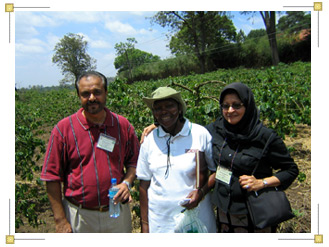
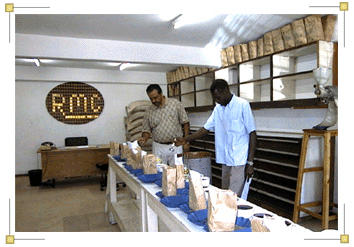
KENYA 98/99 CROP ASSESSMENT UPDATE - 5/25/99 1998 KENYA COFFEE SAFARI - 12/22/98 Each year we host a small group of our customers on a rotational basis to join us on what we call our Kenya Coffee Safari. Our purpose is to demonstrate why Kenya coffees are considered the world's best, and why quality, from seed to cup, is the main thing that really counts. This year's Safari consisted of a seven-day study of the Kenya coffee industry from field to factory, mill, research laboratory, and auction through to our specialized coffee quality control and improvement checkpoint in Mombasa. The weather was good in Kenya for this time of year, not so
oppressively hot as it might be due to a cloud cover for most of the trip. Our first stop
in the seed-to-cup chain was a visit to a
Our next stop in the seed-to-cup chain was the tiny village of Gatomboya. It is the home of small growers and their local wet processing factory. This small town, whose only business is coffee, was the origin of last year's lot that brought the highest price at auction ever recorded ..... the lot we had purchased for Allegro Coffee Company.
Translation:
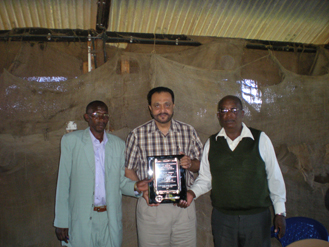
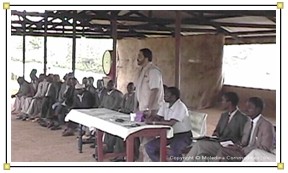
Upon arrival, we were pleasantly surprised with a festive community gathering of 200 villagers staged to honor and thank us with for last year's record purchase of their coffee. During the festivities, one of the village elders rose and honored us for “saving our village of Gatomboya from drowning.” (It had been an otherwise bad year.) And continued: “But what are you going to do for us in the future?” “In the future you will have to learn to swim for yourselves by keeping your quality high.” I replied. The villagers jumped to their feet roaring approval at the exchange.
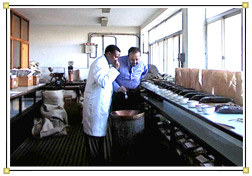
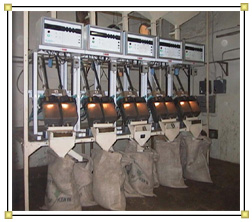
Our visit to the KPCU mill in Nairobi was much different, cast to the forlorn mood portrayed in the “Sounds of Silence.” Even though it was at the usual, brief moment of inactivity between crops, how strange it was to see the catador, screening, and selective sorting machinery shut down and standing idle. Yet, all was OK for in the stillness we could better appreciate the intricacies of the equipment. We also met with the legendary Charles Gatere. What a pleasure to be with the man and cup with him to discern taste, acidity, and quality differentials and assess potential. His expertise, integrity, and personal humility contribute mightily to coffee industry of Kenya. Next in the chain was a visit to the Coffee Research Foundation. A local power outage, didn't stop these scientists from giving us a first rate briefing on their latest research into plant breeding and husbandry, chemistry, economics, plant pathology, and disease and pest control. There is nothing like this in the world and to the world they generously offer the fruits of their labor. A recent example is the Kenya Coffee College Short Course on the production and processing of coffee, a must for those with a serious interest in coffee quality improvement. Next on the list was our visit to the Coffee Board of Kenya, home of the “auction” which handles the orderly and transparent marketing of Kenya's coffee. Mr. Paul Kivila, the Public Relations Office of the CBK, greeted us warmly with an insider's tour of the sample and auction rooms. Of particular interest is the new electronic bidding and record keeping system that speeds up and improves the accuracy of the auction process. It also forces each bidder to do his own quality assessments of the lots he wants to bid on rather than chase after only those lots the three or four bidders known for their due diligence go after. In time, this will even out the often unwarranted price disparities between lots with little or no real differentiation. Of final note was the Safari's visit to our Head Office, Rashid Moledina & Co. (MSA) Ltd. in Mombasa. Here we have our own Quality Coffee Improvement Facility where we do a final scrutiny of all the Coffees we purchase prior to shipment. With our Catador, Screening and Electronic Sorting machines, we are able to re-sort and improve the quality where necessary to insure our customers receive the best coffee possible. KENYA 98/99 CROP ASSESSMENT - 12/22/98 Last year's (97/98) 53,000 ton crop was small, irregular and lower on average in quality than normal due to the worldwide, El Nino fed, climatic shifts. Based on our personal observations and surveys, we expect a 20% increase over last year for the 98/99 crop to perhaps as much as 65,000 tons. This includes a similar increase in quality, all due to the bettering weather conditions. Whatever the conditions, if you want the best of the best, call Moledina Commodities at 1-800-325-3692.
|
|||||||||||||||||||||||||||||||||||||||||||||||||||||||||||||||||||||||||||||||||||||||||||||||||||||||||||||||||||||||||||||||||||||||||||||||||||||||||||
|
©Moledina Commodities Inc. - (All Rights Reserved) |
||||||||||||||||||||||||||||||||||||||||||||||||||||||||||||||||||||||||||||||||||||||||||||||||||||||||||||||||||||||||||||||||||||||||||||||||||||||||||||

 quantities are small to the point that the auction is
on a bi-weekly schedule rather than the usual weekly. However, prices are reasonable and
steady. The next two auctions will take place on December 15th with an
anticipated 40,000 bags offered and then after the traditional break for Christmas
Holidays on January 11th with an estimated 30,000 bags. After that, the usual
weekly auctions should resume.
quantities are small to the point that the auction is
on a bi-weekly schedule rather than the usual weekly. However, prices are reasonable and
steady. The next two auctions will take place on December 15th with an
anticipated 40,000 bags offered and then after the traditional break for Christmas
Holidays on January 11th with an estimated 30,000 bags. After that, the usual
weekly auctions should resume. was not seen as a
threat to the livelihood of the growers we visited in the Nyeri district.
was not seen as a
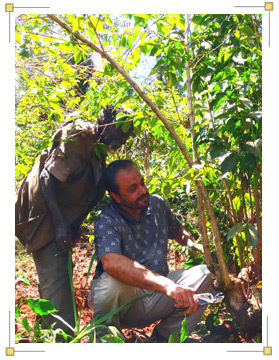
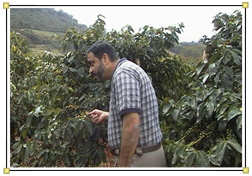
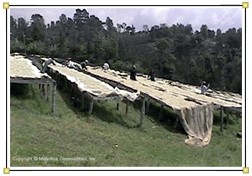
threat to the livelihood of the growers we visited in the Nyeri district.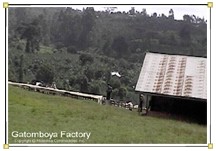 small-scale farm and a large plantation in Nyeri. Both were
beautifully run and husbanded ... lots of cherries, healthy, pruned, and well tended. This
year's crop will be a good one
small-scale farm and a large plantation in Nyeri. Both were
beautifully run and husbanded ... lots of cherries, healthy, pruned, and well tended. This
year's crop will be a good one 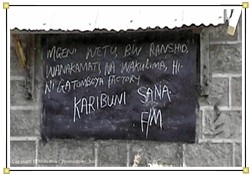
 Always
awkward speaking publicly and never, ever quick witted in such situations, I was thankful
to God for putting these words into my mouth and for their acceptance as the truth by
these hospitable people.
Always
awkward speaking publicly and never, ever quick witted in such situations, I was thankful
to God for putting these words into my mouth and for their acceptance as the truth by
these hospitable people.